
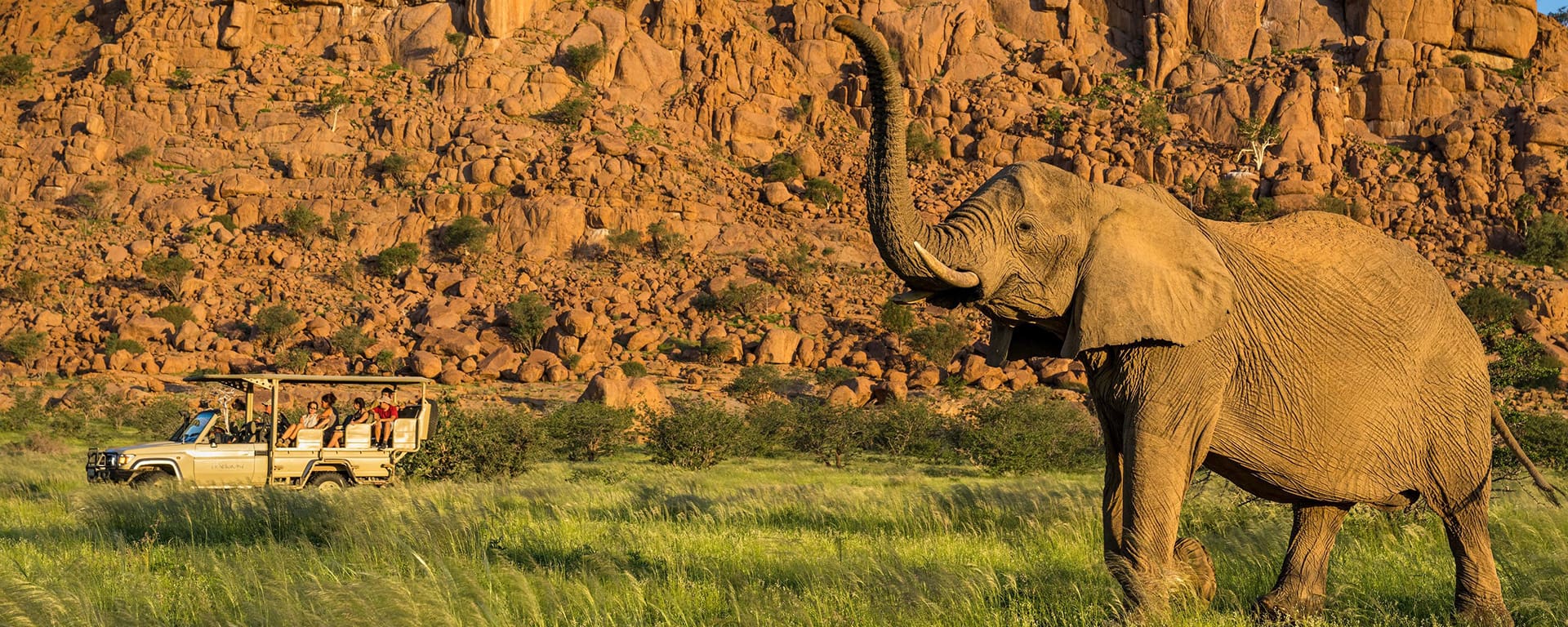
An elephant in the Okavango Delta feeds in shallow water, surrounded by papyrus and permanent channels. An elephant in Damaraland picks its way up a rocky escarpment in near-zero rainfall, covering distances of up to 70 kilometres between water sources, feeding on desert shrubs and stripping bark from sparse riverine trees for moisture. They are the same species. The difference is what decades of survival in an extreme environment produces: a population that has learned to do things that elephants in any other African habitat simply do not do.
This is what makes Namibia’s desert-adapted wildlife one of the most compelling and unusual safari experiences on the continent. The animals here are not rare in the way that a black rhino in thick bush is rare: hidden, elusive, a matter of luck and guiding skill. They are rare because the environment that shaped them is itself rare: one of the world’s oldest and driest deserts, supporting large mammal populations through behavioural adaptations that took generations to develop and that no other population elsewhere replicates.
What “desert-adapted” actually means
The term is important to understand accurately. Desert-adapted animals in Namibia (elephant, lion, black rhino and giraffe) are not distinct subspecies. They are the same species found elsewhere in Africa. What distinguishes them is a set of learnt and inherited behaviours, and in some cases minor physical differences, that allow them to survive in conditions that would be fatal to their savanna counterparts.
Desert-adapted elephants travel vastly greater distances than savanna elephants, up to 70 kilometres between water sources in some documented cases, compared to a typical home range of ten to twenty kilometres for Okavango or Kruger elephants. They have developed knowledge of seasonal water sources that is passed from cow to calf over generations: where the seeps are in the dry riverbeds, which trees hold moisture in their roots, where to dig in dry sand to find water below the surface. Lose a matriarch and you lose the memory of water sources that no other animal in the herd has yet learned.
Desert lions in the Kunene Region have adapted to hunt oryx, springbok, Hartmann’s mountain zebra and, in some documented cases, Cape fur seals on the Skeleton Coast, in a landscape that most lions would find uninhabitable. Their home ranges are among the largest of any lion population on earth, with some individuals ranging over 2,000 square kilometres. They are lean, long-legged and capable of going without water for days, obtaining moisture from the blood of their prey.
Desert black rhino in Damaraland obtain much of their moisture from the succulents and desert shrubs they browse, reducing their dependence on permanent water. They travel further, range more widely and are more solitary than their savanna counterparts. The Palmwag Concession in northwestern Namibia holds one of the world’s largest free-ranging black rhino populations, a conservation achievement built on decades of work by Save the Rhino Trust Namibia and the communal conservancy model that protects their range.
The five desert-adapted species worth knowing
Desert-adapted elephant
Namibia’s desert-adapted elephant population is concentrated in the ephemeral riverbeds of northwestern Namibia, particularly the Hoanib, Huab and Aba-Huab rivers in Damaraland and the Hoarusib River further north in the Kunene Region. These dry riverbeds are where the largest ana trees and camelthorn trees grow, providing the bulk of the elephants’ diet, and where subsurface water can be dug for when the surface is bone dry.
The elephants are well-habituated to safari vehicles in the areas around established camps, and a sighting of a family group moving single-file down a dry riverbed, picking their way through boulders with their feet placed with extraordinary precision on broken rock, is something that no Botswana or Kenya elephant encounter produces. The scale and drama of the landscape around them, and the visible effort of survival in every movement, gives these encounters a weight that more conventional safari sightings lack.
Elephant-Human Relations Aid (EHRA) estimates roughly 150 desert-dwelling elephants across the main ephemeral riverbeds of the northwest: the Ugab, Huab, Hoarusib, Hoanib and Uniab.
Best locations: Damaraland Camp and Doro Nawas Camp (Huab River); Hoanib Valley Camp (Hoanib River); Palmwag Lodge (Palmwag Concession). Self-drive access to the Aba-Huab River near Twyfelfontein is possible on a day visit with a high-clearance vehicle.
Desert lion
The desert lions of the Kunene Region are among the rarest large predators in Africa. The first systematic survey of the population, carried out by Namibia’s Ministry of Environment, Forestry and Tourism with the Lion Rangers, the Namibian Lion Trust and IRDNC over nine weeks in late 2022 and early 2023, put the number at 57 to 60 adults plus 14 cubs. The Desert Lion Conservation project has tracked individual lions by name across this landscape for over three decades. These are the only lions on earth known to regularly hunt and eat Cape fur seals on ocean beaches.
A desert lion sighting is never guaranteed, and that is rather the point of it. The population is small, the home ranges are enormous, and the terrain they inhabit is among the most rugged in Namibia. Guided tracking excursions from camps in the Palmwag Concession and Hoanib Valley give you the best chance, using radio-collar data from the Desert Lion Conservation project and guides with years of experience in this specific landscape. When a sighting occurs, whether a pride resting in the shade of a dry riverbed cliff or a male patrolling the edge of the concession, it carries a quality of wildness that a lion in Etosha or the Mara cannot replicate.
Best locations: Palmwag Concession, Hoanib Valley, Skeleton Coast. Sightings require a specialist camp and a guide with current knowledge of pride locations. Verify current population figures with Desert Lion Conservation (desertlion.info) before your trip.
Desert black rhino
Namibia holds the largest population of black rhino in Africa, and the Palmwag Concession in Damaraland holds one of the world’s most significant free-ranging populations of this critically endangered species. Rhino tracking on foot with a Save the Rhino Trust Namibia tracker and a specialist guide is one of the most conservation-immersive safari experiences available anywhere on the continent.
The tracking process itself, following spoor across rocky ground, reading the direction of travel from broken vegetation and dung and adjusting the approach as the wind shifts, is as compelling as the encounter at the end of it. A black rhino located and approached on foot in Damaraland, standing in a dry riverbed against red rock mountains, is among the most affecting wildlife encounters in Africa. The critically endangered status of the species, with around 6,800 remaining across Africa according to Save the Rhino International, gives every sighting a specific weight.
Best locations: Desert Rhino Camp (Palmwag Concession) is the primary destination, operating with Save the Rhino Trust Namibia trackers as part of the camp experience. Damaraland Camp also offers rhino tracking in a neighbouring area.
Oryx
The gemsbok (oryx) is Namibia’s national animal and the most perfectly engineered large mammal for desert survival. Its physiology is extraordinary: a network of fine blood vessels in its nasal passages cools blood before it reaches the brain, allowing the animal to tolerate body temperatures of up to 45°C without brain damage, a temperature that would be fatal to any other large mammal. It can go for days without drinking, obtaining moisture from the plants it eats. Its straight, rapier horns, more than a metre long, are the most effective anti-predator weapon of any African antelope.
Oryx are common throughout Namibia’s desert regions and are visible on almost any drive in the Namib-Naukluft, Damaraland or the Skeleton Coast. They are so embedded in the Namibian landscape that it is easy to take them for granted, which is worth resisting, because the physiological story behind their survival is as remarkable as anything the desert-adapted megafauna produces.
Best locations: Namib-Naukluft National Park, Damaraland, Skeleton Coast. Visible year-round throughout the desert regions.
Hartmann’s mountain zebra
The Hartmann’s mountain zebra is a Namibia-specific subspecies, found in the rocky mountain terrain of the Namib escarpment and Damaraland. Namibia holds the great majority of the world population, which runs to well over 100,000 animals, and the subspecies is listed as Vulnerable on the IUCN Red List. They are distinguished from plains zebra by the absence of shadow stripes between the main stripes, a dewlap under the chin, and a preference for steep, rocky terrain that plains zebra cannot navigate. Watching a small herd of Hartmann’s zebra move up a near-vertical rocky slope with apparent ease is one of those specifically Namibian moments that no other safari destination produces.
Best locations: Damaraland, Palmwag Concession, Naukluft Mountains. Year-round but most easily seen in the dry season when vegetation is sparse.
Where to go for desert-adapted wildlife
Damaraland
Damaraland is the heartland of Namibia’s desert-adapted wildlife experience and the primary destination for travellers who come specifically for elephant, black rhino and the possibility of desert lion. The region encompasses a series of private concessions and communal conservancies in northwestern Namibia, managed under the community conservation model that Namibia pioneered and that has produced some of the most significant wildlife recovery stories in Africa. The landscape of red rock mountains, ancient river valleys and granite formations dating back 125 million years is among the most dramatic in southern Africa and gives every wildlife encounter a context that a flat-grass savanna cannot.
The main camps in Damaraland (Wilderness Damaraland Camp, Doro Nawas and Desert Rhino Camp) are fly-in destinations accessed by light aircraft from Windhoek or from Etosha, or by self-drive on gravel roads for travellers with a suitable 4×4 vehicle and experience on remote Namibian roads.
Etosha National Park
Etosha is not primarily a desert-adapted wildlife destination in the same sense as Damaraland, since its waterhole-based game viewing is more comparable to a conventional safari park, but it holds significant populations of black and white rhino, desert-adapted lion and cheetah, and the park’s semi-arid character means the wildlife here has adapted to drier conditions than most southern African parks. Etosha’s Halali and Okaukuejo camps are among the most accessible places in Africa to see black rhino at a floodlit waterhole after dark.
The Skeleton Coast
The Skeleton Coast National Park in northern Namibia is the most remote and least visited of Namibia’s main safari areas, accessible only by fly-in. The desert-adapted lion population that hunts seals on its beaches is the primary wildlife draw for specialist travellers, alongside brown hyena, desert-adapted elephant in the Hoarusib River mouth and the largest Cape fur seal colony in the world at Cape Cross (outside the national park). The Skeleton Coast is a destination for travellers who have already done Etosha and Damaraland and want something more extreme.
When to go
Desert-adapted wildlife is present year-round in Damaraland and the Palmwag Concession, which is one of the significant advantages of this destination over seasonal parks elsewhere in Africa. The best months for tracking and walking are May to September, when temperatures are cooler and the dry conditions make spoor-reading on the ground easier. The elephant and rhino populations do not migrate or shift dramatically by season. They follow the ephemeral riverbeds year-round, and their location at any given time is a function of where water and food are available rather than a predictable seasonal movement.
For desert lion specifically, the population’s wide-ranging behaviour means that sightings are possible in any month but genuinely unpredictable in all of them. The Desert Lion Conservation project’s tracking data gives guides the best available information on pride locations, and camps that work closely with this programme offer the highest sighting probability in any given season.
For a full breakdown of Namibia’s seasonal conditions, see our guide to the best time to visit Namibia on safari.
Questions about desert wildlife in Namibia
Are desert-adapted elephants dangerous?
All African elephants are potentially dangerous and should be treated with respect and approached only with an experienced guide. Desert-adapted elephants in areas with established camps have been habituated to vehicles over many years and generally tolerate a respectful approach at reasonable distance. On foot, approaching any elephant requires a professional guide with experience in this specific landscape and population. Never approach elephant on foot without a qualified guide, regardless of how habituated they appear.
Can you see desert lion on a self-drive?
Extremely unlikely. Desert lion range over vast territories and their locations are tracked by the Desert Lion Conservation project using radio-collar data that is shared with specialist guides and camps. A self-drive visitor has no access to this information and the probability of an independent sighting is very low. For any realistic chance of a desert lion encounter, book a camp in the Palmwag Concession or Hoanib Valley that works directly with the conservation monitoring programme.
How does Damaraland compare to Etosha for wildlife?
They are fundamentally different experiences. Etosha is a waterhole-based game viewing safari with high sighting reliability and a wide species range. Damaraland is a tracking and wilderness experience, with lower sighting reliability but a depth of encounter and a landscape context that Etosha cannot match. Most Namibia specialists recommend combining both: three to four nights in Damaraland followed by three to four nights in Etosha covers the full spectrum of what Namibia’s wildlife offers.
Plan your Namibia desert wildlife safari
Namibia’s desert-adapted wildlife is not a substitute for a conventional African safari. It is something different: more demanding, less predictable, and more rewarding for that. The right camps, the right guides and the right conservation connections produce encounters that no other destination in Africa replicates.
Tell us whether elephant, rhino tracking or the desert lion is the draw, and we will match the camps and the conservation partners to it. Plan your safari with a specialist, or browse our Namibia safari itineraries.