

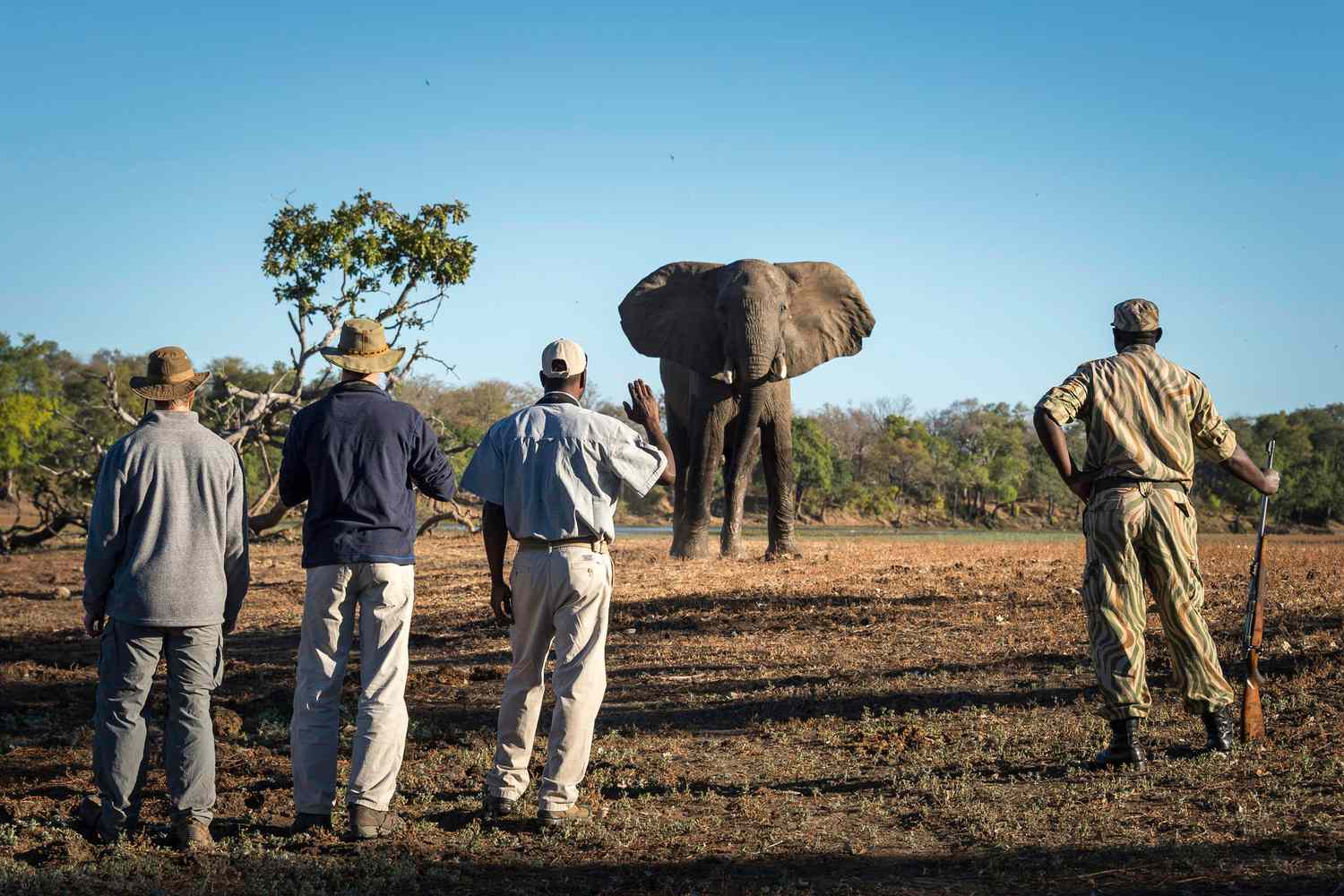
In 1950, a game warden named Norman Carr persuaded Senior Chief Nsefu of the Kunda people in the Luangwa Valley to set aside a portion of tribal land as a game reserve. He built the first game-viewing camp in what was then Northern Rhodesia, and he began taking guests into the bush on foot to watch animals rather than shoot them. The revenue from the camp went back to the Chief. The walking safari, and the idea that wildlife was worth more alive than dead, was born in a single act of conservation that was several decades ahead of its time.
More than seventy years later, South Luangwa National Park remains the place where the walking safari tradition runs deepest. The camps Norman Carr sited are still in operation, managed now by Time+Tide and guided by professionals some of whom were trained by guides who walked with Carr himself. The valley’s walking culture, the quality of its guides and the terrain that makes South Luangwa ideal on foot are still the reason that experienced safari travellers rank it alongside Zimbabwe’s Mana Pools as the finest walking safari destination in Africa.
Why South Luangwa works for walking
South Luangwa National Park covers just over 9,000 square kilometres of the Luangwa River Valley in northeastern Zambia. The valley’s geology is ancient: a rift valley carved by tectonic movement, with the Luangwa River winding through its floor and leaving a trail of oxbow lakes, lagoons and seasonal pools in its wake. This geography produces terrain that is naturally suited to walking safari.
The valley floor is open enough to read across, with patches of mopane woodland and open floodplain alternating with riverine forest along the Luangwa’s banks, giving guides sightlines that allow them to manage close encounters with large mammals without relying on a vehicle for safety. The wildlife density is exceptional, with the Luangwa Valley supporting one of the highest concentrations of leopard in Africa, earning it the name the Valley of the Leopard, alongside lion, elephant, buffalo, hippo, crocodile, wild dog and the Thornicroft’s giraffe, a subspecies found only in this valley.
The wildlife has also been exposed to respectful walking safari for longer than in almost any other African park. Several generations of habituation have produced an animal population that tolerates people on foot at ranges that allow extended observation without stress. This is not the same as tameness, since these are wild animals and the guide manages the encounter accordingly, but it produces the quality of sighting that makes South Luangwa walking safaris exceptional.
The guiding tradition
The walking safari guide in South Luangwa is a specific product of a specific training culture. The Zambia Wildlife Authority guide qualification, combined with the in-house training programmes of the major Luangwa operators, produces guides who have spent years learning the valley on foot before they lead their first group. The best South Luangwa guides know individual animals, particular leopards, specific lion prides and wild dog packs, the way a farmer knows their land. They have walked the same ground through hundreds of dry seasons and read the same signs so many times that the information is instinctive.
Some of the current generation of senior Luangwa guides were trained directly by guides who walked with Norman Carr. The lineage is real, not marketing. It produces a depth of knowledge and a quality of storytelling on a walk that is difficult to find in any other safari context.
As with Zimbabwe, the guide is the product in Zambia. A well-positioned camp with a mediocre guide delivers a lesser experience than a simpler camp with an exceptional one. When choosing a South Luangwa camp for walking, ask specifically about the guiding team, their qualifications and their years in the valley.
Types of walking safari in South Luangwa
South Luangwa offers walking safari in two formats that suit different travellers and different levels of experience.
Guided walks from a fixed camp
Most luxury camps in South Luangwa offer guided morning walks as part of the daily activity programme, alongside game drives and, at some camps, night drives. A morning walk typically runs for two to four hours, departing at dawn and returning to camp before the midday heat. The group is small, usually no more than six guests, with a lead guide and often a scout. The walk covers ground within the camp’s traversing area and follows the information the guide reads as the walk progresses.
This format is the most accessible introduction to walking safari and suits most first-time walking guests. The camp provides the comfort and the walk provides the experience, with no need to carry personal kit or manage anything beyond the walk itself.
Mobile walking safaris
For more experienced or adventurous travellers, mobile walking safaris move between a series of remote bush camps entirely on foot over multiple days. The format that Norman Carr pioneered, walking from camp to camp along the Luangwa and Luwi rivers and camping in remote sections of the park with no other guests in sight, is still available through several South Luangwa operators.
A classic mobile walking safari in South Luangwa covers five to seven days, moving between three or four remote camps and covering eight to twelve kilometres each walking day. Personal luggage is transported between camps by vehicle, so guests carry only what they need for the day’s walk. The camps are simple but comfortable: walk-in tents on raised platforms, shared shower and toilet facilities, a campfire and a cook who produces meals that feel extraordinary given the remoteness of the setting.
This format is physically more demanding than guided walks from a fixed camp. A reasonable level of fitness is required, since the terrain is uneven and the walking days are long. The reward is the purest available form of the experience Norman Carr created: moving through the Luangwa Valley on foot, entirely at ground level with the wildlife, for several consecutive days.
What a walking safari day in South Luangwa looks like
The day begins before sunrise. Coffee and something small to eat at camp, then the guide briefs the group on what was seen overnight, from tracks at the waterhole to sounds from the treeline, and sets the direction for the morning’s walk. You leave the camp perimeter and the guide’s pace tells you everything about the current situation: steady and exploratory means nothing specific has been found yet; slower and more deliberate means something has been located ahead.
The Luangwa in the dry season is fragrant in the early morning, with dust, wild sage and the mineral smell of the river, and the light changes quickly from grey to gold in the first thirty minutes. The guide stops regularly to show tracks, to point out birds by sound before they are visible, to explain what the broken branch above means and which animal left the mark at what height. Walking safari in South Luangwa is as much about the quality of explanation as the quality of the sightings. A guide who can tell you what the ecosystem is doing around you, not just what you are looking at directly, transforms a walk into something lasting.
Encounters with large mammals on foot range from brief and charged, such as a buffalo turning to face the group from forty metres while the guide holds everyone still and reads the animal’s posture before it relaxes and moves away, to extended and extraordinary, such as finding a leopard on a kill in a leadwood tree and spending forty minutes watching her feed. Both produce memories that vehicle-based game viewing rarely matches.
South Luangwa versus Zimbabwe for walking safari
The comparison between South Luangwa and Zimbabwe’s Mana Pools is one that experienced walking safari travellers make regularly, and the answer is genuinely nuanced.
South Luangwa’s case rests on the depth and age of its walking tradition, the quality of the guiding lineage, the extraordinary leopard density and the flexibility of the mobile walking format. The landscape is varied, taking in riverine forest, open floodplain, mopane woodland and oxbow lagoons, and a week-long mobile walk covers genuinely different terrain each day.
Mana Pools’ case rests on the Zambezi River setting, the iconic elephant behaviour in the albida woodland (bulls standing on hind legs to reach pods high in the canopy), the combination of walking and canoe safari and the specific atmosphere of a UNESCO Heritage Site that feels removed from ordinary safari infrastructure. The guiding culture is equally strong and the Zimbabwe professional guide qualification equally rigorous.
For most travellers, the choice comes down to geography and itinerary rather than a quality judgment. Zambia and Zimbabwe are natural companions on a southern Africa trip, and the two walking safari experiences complement each other rather than competing. See our guide to walking safaris in Zimbabwe for a full discussion of what Mana Pools specifically offers.
The camps that define the South Luangwa walking tradition
Several camps in South Luangwa are specifically built around the walking safari experience rather than treating it as an add-on to a drive-based programme. The camps originally sited by Norman Carr along the Luwi River system, namely Luwi, Nsolo and Kakuli, are now part of the Time+Tide collection and remain among the most authentic walking safari camps in Africa. They are small, remote, positioned in the best game areas of the park and reached on foot as part of a multi-day walking itinerary.
Robin Pope Safaris offers a five-day mobile walking safari that moves between remote seasonal camps along the Luangwa and is consistently regarded as one of the finest walking experiences in Africa. The Bushcamp Company operates a network of small camps in the southern Luangwa that are linked by walking trails and offer a high-quality fixed-camp walking programme. Remote Africa Safaris, in the remote Mupamadzi River area, is the most off-grid of the major South Luangwa operators and runs walking safaris in parts of the park that see almost no other visitors.
All of these operations are covered in more detail on our South Luangwa park page.
When to go for walking safari in Zambia
The walking season in South Luangwa runs from late May to mid-November, when the remote bush camps are open and the dry-season conditions allow walking in the game-rich areas of the park. The best months are June to October, with the following progression:
June and July are cool and dry, ideal for walking in terms of temperature and the quality of the bush. August and September see the bush at its driest and the wildlife at its most concentrated along the Luangwa River, and both the predator density and the quality of encounters increase. October is the hottest month but the most intense for game viewing, with walking restricted to the early morning and late afternoon. The carmine bee-eater colonies on the Luangwa’s banks are at their most spectacular in September, a specific South Luangwa highlight that is worth timing a visit around.
For a full breakdown of Zambia’s seasonal conditions by month, see our guide to the best time to visit Zambia on safari.
Questions about walking safaris in Zambia
How fit do I need to be for a walking safari in South Luangwa?
For guided walks from a fixed camp, a moderate level of fitness is sufficient. The terrain is relatively flat and the guide sets a pace that accommodates the group. For a multi-day mobile walking safari, a higher level of fitness is required, since you will walk eight to twelve kilometres per day on uneven terrain, in heat that builds through the morning. You do not need to be an athlete, but you should be comfortable walking for three to four hours in temperatures of 25 to 35°C. Most operators ask guests to self-assess honestly before booking a mobile safari.
What is the minimum age for walking safaris in South Luangwa?
Most South Luangwa camps set a minimum age of 12 for guided walks and 16 for multi-day mobile walking safaris. This varies by operator and by camp. Verify the specific minimum age with your chosen property before booking, as it can differ from the park authority requirement.
Is it safe?
Walking safari in South Luangwa is led by qualified, armed professional guides who have demonstrated, under examination, the ability to manage close encounters with dangerous game. The safety record of properly run South Luangwa walking safaris is strong. What makes it safe is the quality and experience of the guide, the single most important factor in any walking safari decision. Ask specifically about your guide’s qualifications, their years in the valley and their experience with dangerous game before the first walk begins.
Plan a walking safari in Zambia
South Luangwa is where the walking safari began and where its tradition runs deepest. The right camp, the right guide and the right time of year produce an experience that connects directly to Norman Carr’s original idea: that walking with wild animals in the African bush, learning their world at ground level, is worth more than anything you can experience from a vehicle.
Tell us how many days you want on foot and how remote you want the camps, and we will build the walking itinerary around it. Plan your safari with a specialist, or browse our Zambia safari itineraries.