

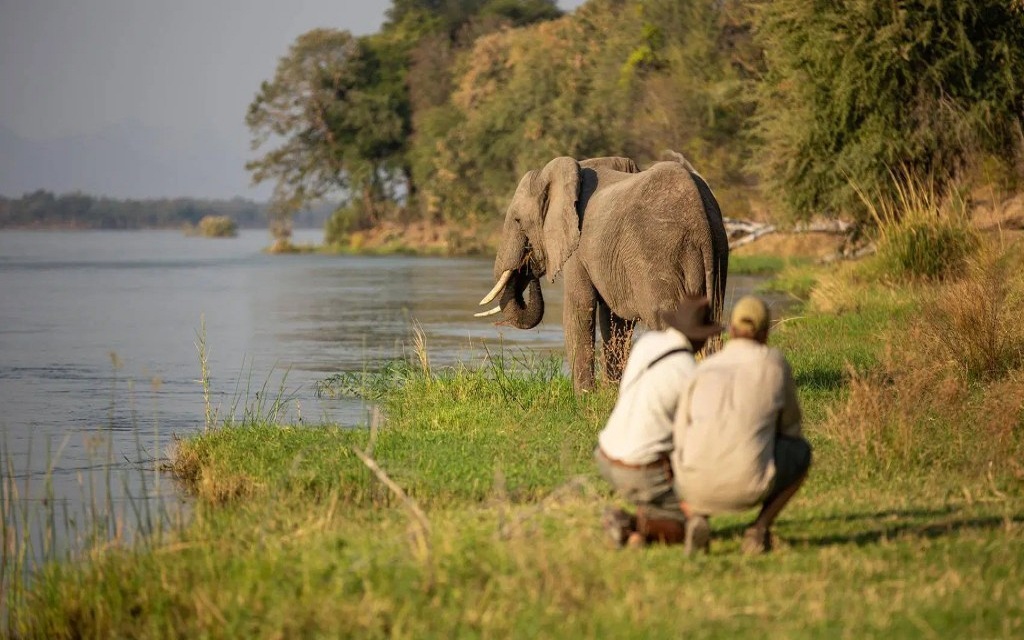
There is a moment, somewhere in the first hour of a walking safari in Mana Pools, when something shifts. It happens when the vehicle has been left behind, the guide has settled into a pace that feels deliberate rather than hurried, and you realise that the sounds you were barely registering from a Land Cruiser, a francolin calling from somewhere in the albida woodland, the crack of a branch under an elephant forty metres ahead, the particular quality of silence that means something has noticed you, are now the primary information you are processing. You are no longer watching the bush. You are in it.
This is what walking safari in Zimbabwe offers, and why Mana Pools is regarded by guides, photographers and repeat safari travellers as the finest place on earth to experience it. Not because it is the easiest or the most comfortable, but because the terrain, the wildlife, the guiding tradition and the philosophy of the park combine to produce something that cannot be replicated from a vehicle.
Why Zimbabwe leads Africa in walking safari
The walking safari tradition in Zimbabwe is old, deep-rooted and rigorously maintained. Professional guides in Zimbabwe qualify through the Zimbabwe Professional Hunters and Guides Association (ZPHGA), an organisation that sets one of the most demanding guide qualification standards on the continent. The process requires years of apprenticeship under experienced guides, advanced knowledge of animal behaviour, ecology, tracking and birdlife across Zimbabwe’s varied ecosystems, and rigorous proficiency with firearms, the final safeguard that allows walks to take place in terrain with large predators.
The result is a guiding culture that is genuinely different from any other country in Africa. A Zimbabwe professional guide reads the bush at a depth that comes from years of walking it. They know not just what an animal track means but what it means in relation to the wind, the time of day, the season and the specific terrain you are in. They communicate on a walk through hand signals, eye contact and a raised fist that freezes the group instantly and silently. The walk happens within that communication, and the quality of the experience depends almost entirely on the quality of the guide.
This is why choosing a camp in Zimbabwe based primarily on accommodation design or amenities misses the point. In Zimbabwe more than anywhere else in Africa, the guide is the product.
Mana Pools: why it works on foot
Mana Pools National Park covers 220,000 hectares of the Zambezi River Valley in northern Zimbabwe and is a UNESCO World Heritage Site. The name comes from the Shona word for “four”, after the four large permanent pools left inland by the Zambezi’s seasonal meanderings, which draw and concentrate wildlife throughout the dry season.
The park works as a walking destination for reasons that are specific to its ecology and geography. The seasonal flooding from the Zambezi creates a mix of open floodplains, albida woodland and riverine forest that produces good visibility and readable terrain: you can see across open ground, track movement through sparse vegetation and read the landscape as it slopes toward water. The wildlife, particularly the elephants, has been exposed to respectful walking safari for decades and has developed a tolerance for people on foot that makes close-range encounters possible without stress to either party.
The albida trees, or ana trees, with their white pods hanging in dense clusters from December to March, are the signature feature of Mana Pools and the reason its elephant population behaves in ways that are unlike elephants almost anywhere else. Bulls that have learned to stand on their hind legs to reach pods high in the canopy, their front feet planted against the trunk and their full height extended, are a Mana Pools image that has appeared in more wildlife documentaries and photography books than any other single behaviour from the park. On foot, at fifteen metres, it is something else entirely.
What a walking safari in Mana Pools actually involves
Walks typically depart in the early morning, between 5.30am and 6am, when temperatures are cool and animals are most active. The group, usually no more than six guests with a lead guide carrying a rifle and often a tracker working ahead, moves at a pace set by the guide. There is no fixed route. The guide reads sign as the walk progresses: tracks, dung, disturbed vegetation, the behaviour of birds, the alarm calls of baboons or impala. The walk follows the information.
Communication on a walk is almost entirely non-verbal. A raised hand means stop. A closed fist means freeze and be silent. A slow downward gesture means drop slowly. These are the signals every guest learns before the first walk begins, and they are followed without question because the guide’s read of the situation is the only one that matters in that moment.
The distance covered in a morning walk varies enormously. Some walks cover three kilometres in two hours; others cover one in ninety minutes because an encounter has developed that demands patience and stillness. The experience is not about distance. It is about the quality of attention that walking demands and produces, a level of sensory engagement that a vehicle simply cannot generate.
A typical morning in Mana Pools in September might begin with a walk along the Zambezi floodplain at first light, with hippos moving back to the water from their overnight grazing on the bank. The guide picks up wild dog tracks from the previous night and adjusts the route toward the area they used, knowing from the track age and the direction of travel where the pack is likely to be resting in the mid-morning heat. The walk finds the pack. The group stops forty metres away. The dogs are aware of the presence but unconcerned, and the group watches for thirty minutes before the guide leads them quietly away. This is a specific sequence of events. It required the guide to read tracks, anticipate movement, make a decision and execute a quiet approach. No vehicle produces this.
Walking safari in Hwange: a different experience
Hwange National Park offers a different but equally compelling walking experience. Zimbabwe’s largest national park covers nearly 15,000 square kilometres of mopane woodland, teak forest and open savanna in the northwest of the country, and its walking safari tradition is built around the waterhole system rather than the river terrain of Mana Pools.
Several private concessions and lodges within and bordering Hwange offer guided walks that use the same ZPHGA-qualified guide standard as Mana Pools. The terrain is different, denser bush in some areas and more open in others, and the signature experience is the waterhole approach: walking quietly through mopane woodland to a pumped waterhole where elephant, buffalo and predators are concentrated, taking a position downwind and watching from ground level. The sunken hides available at some Hwange lodges extend this experience further, allowing guests to watch at eye level with drinking animals from a concealed position underground.
Hwange’s wild dog population also makes walking in the right areas exceptionally rewarding during denning season from June to August. Guides who know the location of active dens can plan walks that approach the den site from downwind and allow extended observation of pack behaviour, including pups, at very close range.
Walking safari and canoe safari: the Mana Pools combination
Most Mana Pools itineraries combine walking safaris with canoe safaris on the Zambezi, and the two activities complement each other in a way that makes the park feel complete. The canoe offers a completely different perspective at water level, moving slowly and silently past hippo pods, crocodiles on sandbanks, elephant drinking on the bank opposite, and the extraordinary birdlife of the Zambezi corridor. The walking produces the bush encounter; the canoe produces the river encounter. Together they cover the full ecological character of the park in a way that game drives alone cannot.
Multi-day canoe trails, travelling between camp sites along the Zambezi, camping on sandbanks and walking at each stop, are one of the most adventurous and rewarding safari experiences available in Africa. These are run by a small number of specialist operators with decades of experience on the river. They require a reasonable level of fitness and a tolerance for basic camp conditions, and they produce encounters with wildlife that no vehicle or fixed camp can match.
What to expect physically and practically
Walking safaris in Mana Pools require a moderate level of fitness. Walks are not hikes, since the terrain is relatively flat, but the pace and the heat, particularly in September and October, demand physical engagement. A pre-dawn start, walking in temperatures that reach 35°C or above by mid-morning, with a focus and alertness that vehicle game drives do not require, is genuinely tiring in a way that is also deeply satisfying. Most guests find that the first walk is the most surprising for what it demands physically and produces experientially.
Footwear should be closed, comfortable and broken in before the trip. Colours should be neutral, khaki, olive or brown, for the same reasons as all bush clothing. Scent should be minimised. Walking guides brief guests thoroughly before the first walk, and the briefing should be taken seriously.
The minimum age for walking safaris in Mana Pools is typically 16, though this varies by operator. Verify the specific minimum age with your camp before booking. Walking safari is not suitable for very young children, and most serious walking safari camps do not accept children under 12.
When to go for walking safari in Zimbabwe
The walking season in Mana Pools runs from late April or early May, when the park reopens after the wet season, through to the end of October when the rains arrive and the vehicle tracks become impassable. The best months for walking are June to October, with September and October producing the most dramatic conditions: extreme heat, contracted water sources and wildlife density that reaches its annual peak.
For first-time walking safari visitors who want excellent conditions without the most extreme heat, June and July are the optimal entry point. The dry season is well established, temperatures are manageable, the wildlife is concentrated and the guiding operates at full capacity. For experienced walking safari guests who want the most intense experience the park can deliver, September is the answer.
For a full breakdown of Zimbabwe’s seasonal conditions by park and month, see our guide to the best time to visit Zimbabwe on safari.
Questions about walking safaris in Zimbabwe
Is walking safari dangerous?
Walking safari involves genuine risk, which is exactly why Zimbabwe’s guide qualification standard exists. A ZPHGA-qualified professional guide carries a high-calibre rifle and has demonstrated, under examination, the judgement to manage close encounters with dangerous game safely. The risk is real and it is managed. In several decades of professionally guided walking safaris in Zimbabwe, the safety record of properly run operations is strong. What makes it safe is the quality and experience of the guide. This is the single most important question to ask when choosing a camp for a walking safari: who will be guiding, and what is their qualification and experience?
How is walking safari different from a game drive?
The difference is not primarily about what you see. It is about how you experience what you see. On a game drive, you observe from a vehicle. On a walk, you are a participant in the environment, reading it, moving through it and responding to it. The sensory experience is completely different: smell, sound and the physical sensation of the ground underfoot become primary. Wildlife encountered on foot, at the same level and without the vehicle as a psychological buffer, produces a quality of attention and memory that vehicle game viewing rarely matches.
Which is better for walking safari: Mana Pools or Hwange?
They deliver different experiences and suit different travellers. Mana Pools, with the Zambezi River, the albida woodland, the habituated elephants and the combination of walking and canoeing, is the most celebrated walking safari destination in Africa. Hwange offers exceptional walking in a different landscape, with the waterhole dynamic and the densest elephant population in Africa as its signature. Most Zimbabwe specialists recommend combining both on a single itinerary, and the contrast between them is part of what makes a Zimbabwe safari exceptional.
Plan a walking safari in Zimbabwe
A walking safari in Zimbabwe is the most direct engagement with wild Africa that safari travel offers. The right guide, the right park and the right season produce an experience that is genuinely unlike any other kind of wildlife encounter. Our specialists can help you structure the right itinerary around both Mana Pools and Hwange.
Tell us how much of the trip you want on foot and we will match the guide and the camp to it. Plan your safari with a specialist, or read our companion guide to walking safaris in Zambia.