

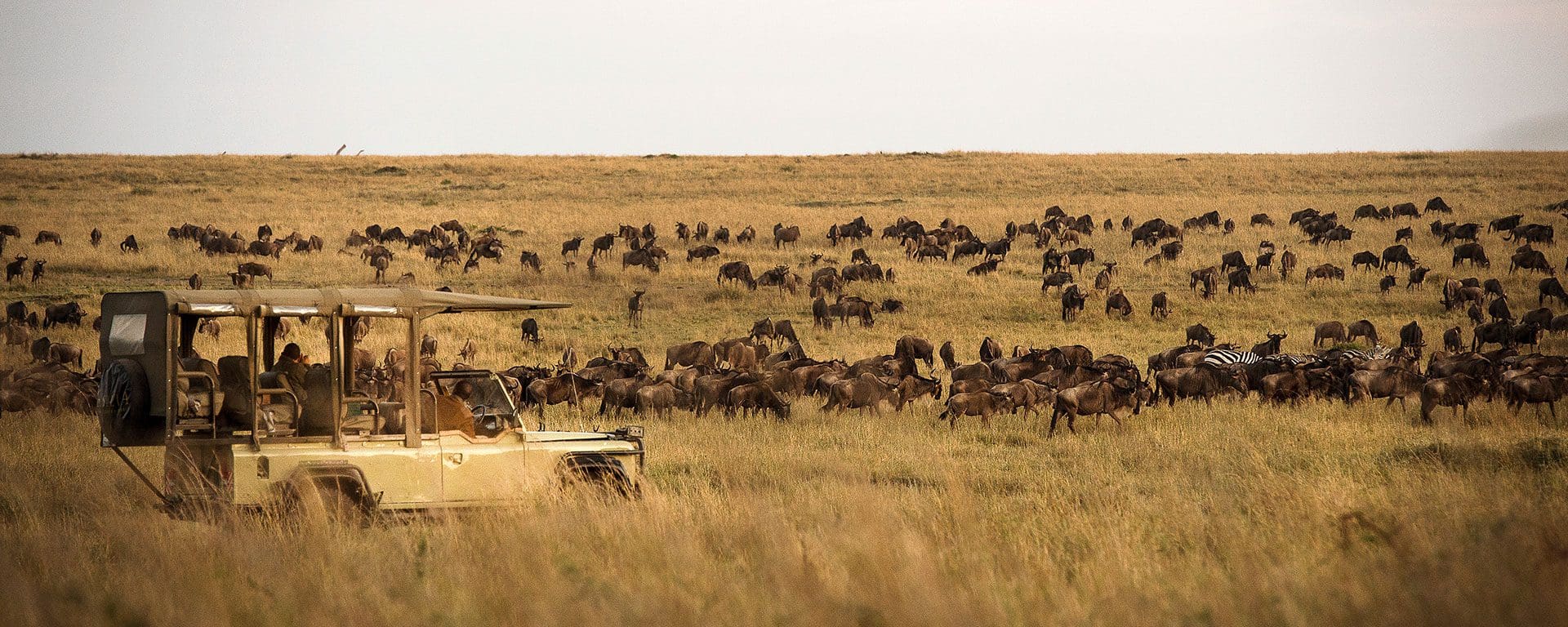
The Masai Mara and the Serengeti are not rivals. They are two parts of the same ecosystem, separated by a line on a map that the wildlife ignores entirely. The wildebeest herds that cross the Mara River in August were grazing on the Serengeti’s southern plains in February. The lions that patrol the northern Serengeti share their range with cats that move into Kenya. The border is a human construct. The wilderness is one continuous thing.
And yet the experience of visiting each is genuinely different. The Mara is compact, concentrated and immediately rewarding. The Serengeti is vast, varied and immersive in a way that takes longer to appreciate. Choosing between them is not a question of which is better. It is a question of what kind of safari you are after, when you are travelling and what your budget allows.
This guide gives you an honest comparison across the factors that actually matter, and a clear verdict by traveller type at the end.
The core differences at a glance
| Factor | Masai Mara (Kenya) | Serengeti (Tanzania) |
|---|---|---|
| Size | ~1,510 km² | ~14,750 km² |
| Migration window | July to October (herds in Kenya) | Year-round movement across the park |
| Wildlife density | Very high per km², concentrated | High in absolute numbers, dispersed over a larger area |
| Atmosphere | Compact, active, fast sightings | Vast, immersive, longer drives between sightings |
| Vehicle numbers | High in peak season in the reserve; low in conservancies | Lower overall; varies by zone and season |
| Park fees (approx 2026) | $100–$200/person/day (Mara reserve) | $71-$83/person/day (Serengeti) |
| Lodge costs | Generally 20–40% lower than comparable Tanzania product | Higher on average, particularly in private concessions |
| Off-road driving | Conservancies only; not in main reserve | Private concessions only; not on standard park tracks |
| Night drives | Conservancies only | Private concessions only |
| Nearest hub | Nairobi (~45 min by air, 5–6 hrs by road) | Arusha (~1 hr by air to central Serengeti) |
| Circuit combinations | Mara plus Amboseli, Samburu or Kenyan coast | Serengeti plus Ngorongoro, Tarangire or Zanzibar |
Wildlife and game viewing
Both parks are home to all of the Big Five and to exceptional year-round predator populations. The meaningful differences are in density, atmosphere and timing.
The Mara’s compact size means that wildlife is concentrated in a relatively small area. A short drive from most camps can deliver lion, elephant, buffalo and cheetah in a single morning. For a first-time safari traveller with three or four nights, this concentration is a significant advantage. Sightings come quickly and frequently, and the risk of a quiet day is lower than in a larger park where animals are more dispersed.
The Serengeti’s scale produces a different experience. Drives can cover large distances across varied terrain, from the short-grass plains of the south to the rocky kopjes of the central Seronera area to the wooded hills of the north. Individual sightings can feel more private simply because of the space between you and other vehicles. The diversity of habitats also supports greater species variety, with over 500 recorded bird species compared to around 450 in the Mara.
For predator density, the Mara edges the Serengeti in most months, particularly for cheetah on open plains and for the concentrated lion prides that follow the herds. For sheer scale and the feeling of being inside an enormous, uninterrupted wilderness, the Serengeti has no rival in East Africa.
The Great Migration
This is the factor that drives most comparisons, and it rewards careful reading.
The herds spend roughly nine to ten months of the year in Tanzania, moving in a continuous loop through the Serengeti. The calving season in the southern Serengeti, from January to March, produces thousands of newborn wildebeest daily and the predator activity that follows them. It is a wildly underrated safari experience that most first-timers overlook because it does not produce river crossings. The western corridor sees Grumeti River crossings from June onwards. The northern Serengeti hosts river crossings at the Mara River before the herds push into Kenya.
The Mara’s Migration window runs broadly from July to October, with the river crossings at their most frequent and dramatic in August and September. The Mara River crossings during these months are among the most iconic scenes associated with African safaris, and the Mara Triangle’s crossing points are among the most accessible in the entire ecosystem.
The honest implication of this is that the Serengeti offers a longer and more varied Migration experience across the year, while the Mara delivers the most concentrated and dramatic crossing season in the shorter July to October window. If crossing season is specifically your goal, either the northern Serengeti or the Mara will serve you in August and September. If you want to follow the full annual cycle, Tanzania is where most of it happens.
River crossing dates cannot be predicted. Book a window of three to four nights around your target period and come with open expectations. Any operator that offers guaranteed crossing dates is overstating what is possible.
Cost
The Masai Mara is generally the more affordable option at every price point, for two reasons. First, there is more competition among camps and lodges, which holds rates down. Second, the proximity to Nairobi reduces internal flight costs. Taken together, the Mara runs 20 to 40 percent cheaper than comparable Tanzania product at most price points.
The Serengeti’s remoteness and the Tanzanian government’s concession fee structure push costs higher. A comparable luxury camp in the northern Serengeti typically costs more than its Mara equivalent, and a multi-camp Serengeti itinerary requires more internal flights, each adding $200 to $500 per person per leg.
Park fees run in the opposite direction. The Masai Mara National Reserve charges around $200 per person per 24 hours in peak season, which is higher than the Serengeti’s $71 to $83 per person per day. Since July 2024 the Mara ticket is also valid for 12 hours rather than 24, so guests staying inside the reserve can be charged for two entries across a single day and night. For a three-night stay during peak season, the Mara’s park fees alone add around $600 per person before accommodation. Conservancy camps in Kenya bundle their fees into the accommodation rate, which makes them look more expensive but can represent better value once all costs are factored in.
In practice, a seven-night luxury safari in the Mara (including internal flights from Nairobi) typically costs $8,000 to $15,000 per person. An equivalent Tanzania itinerary covering the Serengeti runs $10,000 to $18,000 per person. Both figures are rough benchmarks based on publicly available operator pricing in June 2026; actual quotes will vary significantly by lodge, season and itinerary.
Crowds and exclusivity
This is where the comparison gets most nuanced. The answer depends entirely on where you stay.
In the main Masai Mara National Reserve during peak Migration season, vehicle numbers at major sightings can be significant. Twenty or more vehicles at a single lion sighting is not unusual at the most popular crossing points in August. This is the experience that draws criticism of the Mara as “overcrowded.”
The private conservancies tell a different story. Mara North, Olare Motorogi and Naboisho cap vehicle numbers at sightings, permit off-road driving, and allow night drives. The exclusivity is genuine and the wildlife experience is fundamentally different from the reserve. Staying in a Mara conservancy during peak season costs more than a reserve camp but avoids almost all of the crowding.
The Serengeti’s vastness naturally dilutes vehicle numbers outside the most popular zones. The central Seronera area can be busy around well-known sighting spots, but the northern Serengeti and private concessions in the western corridor feel significantly more exclusive. The Serengeti’s size is its most reliable crowd management tool.
For travellers who prioritise exclusivity above all else, a conservancy camp in the Mara and a private concession in the northern Serengeti are broadly comparable. The difference is in atmosphere and landscape rather than exclusivity.
Can you combine both?
Yes, and for many travellers this is the most satisfying answer. A combined Kenya and Tanzania itinerary of ten to fourteen nights, spending time in the Mara and the Serengeti (with the Ngorongoro Crater as a natural addition), covers the full Migration story and delivers the contrast between the two ecosystems in a single trip. Cross-border logistics are well-established: a bush flight from the northern Serengeti to the Mara, or a road crossing at the Kenya-Tanzania border, is routinely managed by specialist operators.
Budget for $12,000 to $25,000 per person for a combined luxury itinerary of this kind, excluding international flights. The range is wide because lodge choice and season affect costs significantly.
Verdict by traveller type
| Traveller type | Verdict |
|---|---|
| First safari, 4–5 nights | Masai Mara. Compact size and high wildlife density reward a short stay. Faster, more frequent sightings. |
| Migration river crossings specifically | Either in August to September. Mara is more accessible from Nairobi; northern Serengeti offers the crossing with more space around it. |
| Full Migration cycle (calving to crossings) | Serengeti. The herds are in Tanzania for nine to ten months of the year. The Mara window is two to three months. |
| Budget-conscious luxury traveller | Masai Mara. Lower lodge rates and closer to Nairobi mean lower total cost at equivalent quality. |
| Sense of vast wilderness | Serengeti. Ten times the size of the Mara, with varied habitats and the feeling of genuine immensity. |
| Avoiding crowds | Mara conservancy or northern Serengeti. Both deliver exclusivity if you choose the right property. |
| Photographer | Mara conservancy for off-road positioning and night drive access. Serengeti for dramatic landscape and calving season. |
| Combining parks in one trip | Tanzania wins on circuit. Serengeti plus Ngorongoro plus Zanzibar is one of Africa’s great itineraries. Kenya’s northern circuit (Samburu, Mara, coast) is strong but less iconic. |
| Repeat East Africa traveller | Both. A combined itinerary completes the Migration story and delivers the contrast of the two ecosystems. |
Questions about Masai Mara vs Serengeti
Which has better leopard sightings?
Neither, in the sense that leopard sightings in both parks depend heavily on guide quality and luck. The Mara conservancies, particularly Olare Motorogi, have habituated leopard populations that allow close approach. The Serengeti’s central kopjes area around Seronera is known for leopard resting in trees. The Sabi Sand in South Africa is the benchmark for reliable leopard sightings in Africa; neither the Mara nor the Serengeti matches it on consistency.
Is it possible to visit both in one trip?
Yes. A ten to fourteen-night itinerary combining both is logistically well-established and covered by several of our East Africa itineraries. The most common structure is three to four nights in the Serengeti (including Ngorongoro), crossing into Kenya for three to four nights in the Mara. Cross-border logistics require a specialist operator who handles both sides; verify visa requirements for both countries before booking.
Which is better for a honeymoon?
Both work well. The Mara has some of the most architecturally dramatic camps in Africa (Angama Mara on the escarpment, Mahali Mzuri in the conservancy). Tanzania adds the option of Zanzibar as a beach extension, which makes it the stronger choice for a bush-and-beach honeymoon in a single country.
Plan your East Africa safari
The right answer depends on your timing, your budget and what kind of experience you are after. Both ecosystems are exceptional. The differences between them are real but they are differences of scale and emphasis, not of quality.
For the seasonal detail behind this comparison, see our guides to the best time to visit Kenya and the best time to visit Tanzania, or read our camp guides for the Masai Mara and the Serengeti. When you are ready, plan your safari with a specialist.