

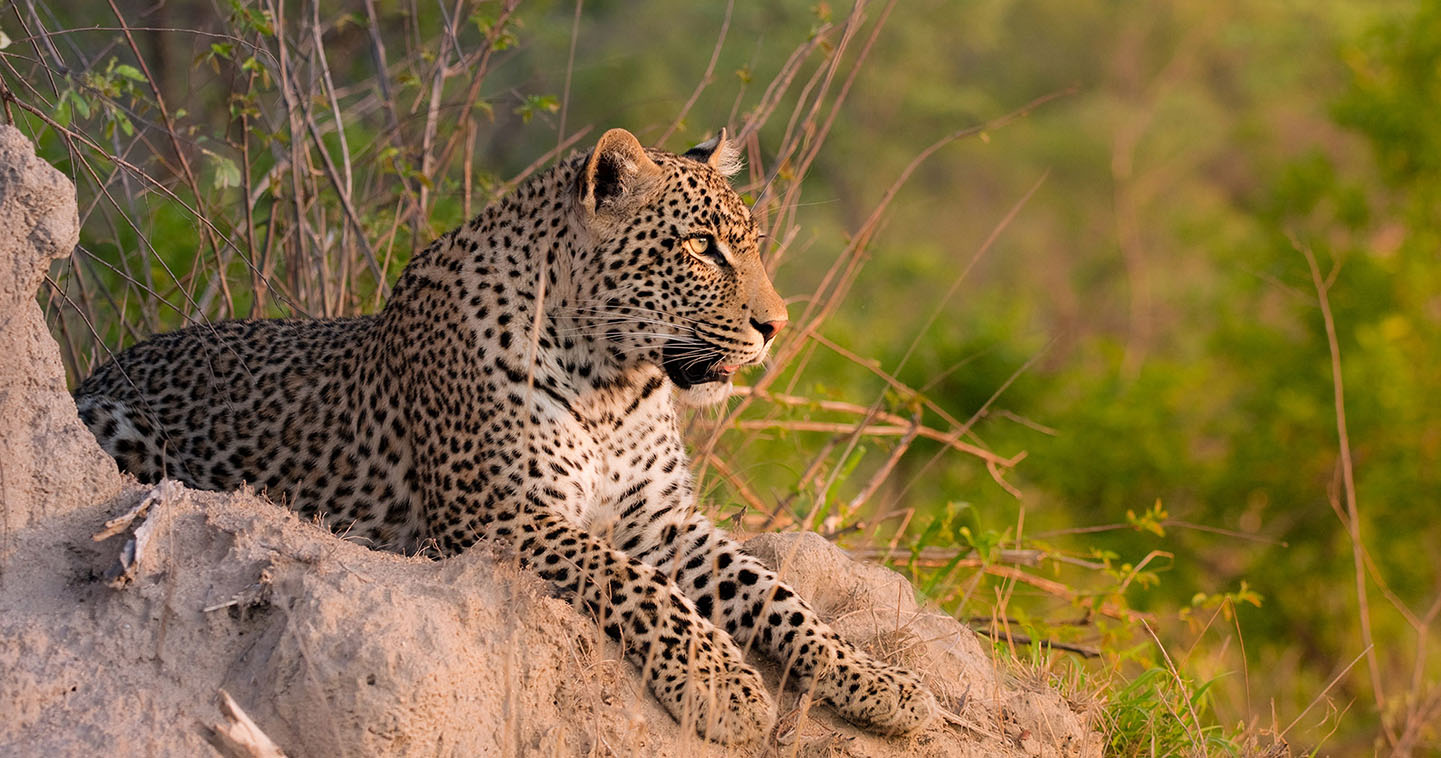
The Sabi Sand Nature Reserve produces the most reliable leopard sightings in Africa, and the reason has less to do with luck than with more than four decades of patient guiding. Everywhere else on the continent, finding a leopard is a matter of tracking skill, time and considerable good fortune. The animal is solitary, largely nocturnal, perfectly camouflaged and inclined to avoid attention. In the Sabi Sand, on the western boundary of Kruger National Park, leopards rest in marula trees, haul impala into the canopy, move through riverine thicket at dusk and raise cubs in drainage lines with safari vehicles present at close range and apparently disregarded.
This is not tameness. It is habituation: a learnt indifference to vehicles, passed from mother to cub across generations, and the product of decades of low-impact guiding by teams who never pushed an approach and always retreated when an animal showed stress. The result is leopard viewing of a quality that no other reserve in Africa sustains as consistently.
This guide explains how that happened, what a Sabi Sand leopard sighting actually involves, which camps sit in the strongest leopard territory and when to go.
Why the Sabi Sand is different from every other leopard destination
The story begins in 1979 with a single young female at Londolozi who, unusually, did not flee from people. Londolozi’s records name her the Mother Leopard. John Varty and the tracker Elmon Mhlongo spent 12 years following and filming her, and she went on to raise 12 cubs to independence, against a typical average of three or four for a female leopard. Her cubs grew up with vehicles present from birth and learnt the same indifference. Londolozi now tracks seven generations of her descendants.
That is the crucial point about habituation: it is generational, not technical. It took almost 50 years and it cannot be shortened. No amount of good guiding in a newer reserve reproduces what a leopard learns from a mother who was herself relaxed around vehicles, which is why the Sabi Sand’s sightings sit in a category of their own.
The second factor is ecology. The 65,000-hectare Sabi Sand Nature Reserve supports what Londolozi describes as the highest leopard density yet surveyed in Africa, sustained by an exceptional prey base of impala, nyala, bushbuck, steenbok, warthog, young kudu and baboon. The reserve holds multiple resident territorial leopards whose home ranges are known in detail to the guiding teams, so a given section of the reserve tends to have known individuals that guides can locate through tracking, radio communication and years of accumulated knowledge of that specific animal’s routes and habits.
The third factor is the rules. As a private reserve rather than a national park, the Sabi Sand permits off-road driving where conditions and habitat allow, and night drives with a spotlight. Sightings are also managed: the Tengile MalaMala Collection, for example, caps a sighting at three vehicles with rotation when needed. Those two things together, access and restraint, are what turn a located leopard into an hour of unhurried observation rather than a glimpse.
What a Sabi Sand leopard sighting actually involves
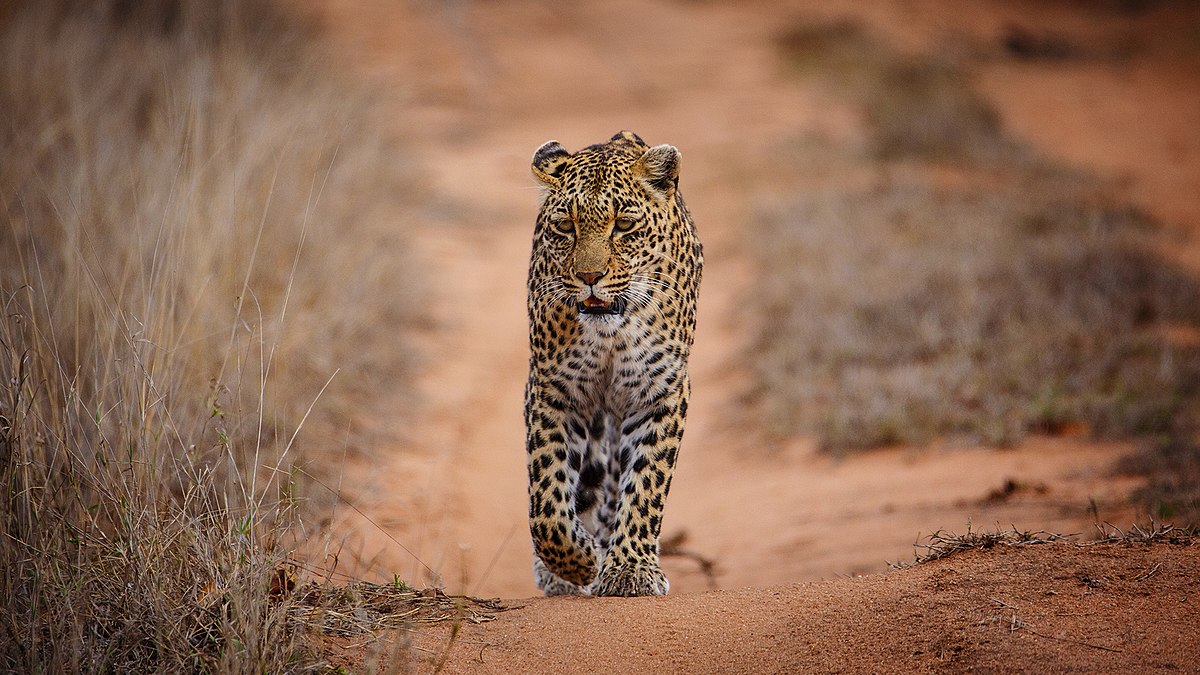
It begins with the tracker. Working from a seat mounted above the bonnet, the tracker reads the ground continuously while the guide drives: fresh pugmarks in the dust, a scrape on a termite mound, a drag mark across a sandy drainage line, the alarm calls of francolin from a particular direction. When fresh sign appears the pace changes. The tracker often descends and works on foot, the guide positions the vehicle to approach from downwind, and guests are asked to sit still and stay quiet.
What follows depends on the animal. A leopard located in the fork of a marula in mid-morning may hold that position for an hour with the vehicle five or 10 metres below. It looks down occasionally, yawns, shifts and sleeps again. At that range you can see the amber of the eyes, the rosette pattern on the flanks and the flick of the tail tip, which is a quality of observation no documentary conveys and a photograph only partly captures.
A hunting leopard is a different experience. A female moving through riverine forest in late afternoon, belly low and ears forward, working towards impala that have not yet registered her, with the vehicle following at a distance and the engine off, produces a tension specific to being there. Whether the hunt succeeds or fails, watching it unfold from close enough to hear grass move underfoot is what people mean when they say a Sabi Sand safari changed something for them.
The individual leopards and the knowledge that surrounds them
One of the defining qualities of the Sabi Sand is that the animals are known individually: named, photographed, documented and understood at a level of detail that turns a sighting of “a leopard” into a sighting of a specific animal with a history. The guiding teams at the long-established lodges hold cumulative records spanning decades, and the reserve’s operators work with research partners including Panthera on predator monitoring.
When a guide can tell you which drainage line the female you are watching was born in, which territory her mother held and which male currently moves through her range, you are no longer simply looking at a leopard. You are reading a story that has been running in this piece of ground for years. Nowhere else in African safari travel is that continuity of record so deep for a single species.
Night drives and the hunting leopard
Leopards are crepuscular and nocturnal hunters, most active in the hours around and after dark. Night drives are standard practice on private reserves in the Greater Kruger and are not permitted in the national park, which is a large part of why the Sabi Sand shows you behaviour that Kruger self-drivers rarely see.
A leopard resting beside an impala kill draped over a branch, picked out by a spotlight, is the image most strongly associated with this reserve. It is also common. Finding a kill hoisted into a tree on an evening drive and returning at first light to find the cat still feeding is a sequence many guests experience on a five-night stay. Few reserves in Africa can offer that as a realistic expectation rather than a hope.
Where to stay for leopard sightings in the Sabi Sand
Every lodge in the reserve benefits from the same leopard density and the same habituation. The differences come down to three things: the traversing area a camp’s vehicles can access, the depth of its guide and tracker team, and the camp’s own history with the leopards in its section. Room counts and details below are taken from each property’s own materials and were checked in September 2026.
Londolozi is where the habituation began and remains the property most closely bound up with the reserve’s leopard story. Five camps sit on one concession on the Sand River, from the six-suite Tree Camp in the leadwood canopy to the larger and more sociable Varty Camp, with Founders, Pioneer and the Private Granite Suites in between. The depth of documented knowledge about individual animals here is unmatched.
MalaMala now sits within the Tengile MalaMala Collection, which holds 20 kilometres of perennial Sand River frontage across MalaMala Camp, Sable Camp, Kirkman’s Kamp, Rattray’s and Tengile River Lodge. The collection reports the lowest vehicle-to-land ratio in the Sabi Sand area and caps sightings at three vehicles. MalaMala has been community-owned since a land claim was settled in 2013.
Singita Sabi Sand runs two lodges on a concession known for high predator density: Ebony Lodge, which opened in 1993, and Boulders Lodge, each with 12 suites. These are the most design-led properties in the reserve and sit at the top of the rate spectrum.
Leopard Hills occupies a rocky outcrop in the western sector with eight glass-fronted suites, each with a private plunge pool and a long view across the bush that the flatter river camps cannot offer.
Savanna is a nine-suite lodge, seven of them canvas-topped, traversing more than 10,000 hectares. The scale of the camp is the point: a small guest number on a large traverse produces private sightings that busier lodges cannot always match.
Cheetah Plains takes a different approach again, with three private villas of four suites each, so a villa is booked exclusively by one party with its own guide, tracker and vehicle. The game viewers are fully electric and silent, which changes the character of a close leopard sighting considerably.

Why the leopard stands apart from the rest of the Big Five
The Sabi Sand is a Big Five reserve and all five are seen regularly. What makes the leopard worth discussing separately is consistency. Lion, elephant, buffalo and rhino are reliable here, but they are reliable in most good southern African reserves. The leopard is different in kind rather than degree: the frequency of sightings, the proximity and the behaviour you witness, from a hunt to a kill in a tree to a female with small cubs, add up to something categorically unlike seeing a leopard elsewhere. If you want the background on the group as a whole, our guide to the Big Five and where to see them sets out the origins of the term and the best reserve for each species.
For travellers who have seen lion and elephant many times and want an encounter that feels genuinely new, this is it.
When to go for leopard in the Sabi Sand
Leopard sightings hold up all year. The dry winter months from May to September strip the vegetation back and give the clearest sightlines, which makes following a moving cat far easier and is the period most photographers choose. The green season from November to March brings cub sightings, as females den during the wetter months and begin bringing young cubs into the open, along with lower rates and dramatic afternoon light.
Neither season is a compromise for leopard specifically. For the wider seasonal picture, including rainfall, malaria risk and how the Cape fits into the same trip, see our month-by-month guide to the best time to visit South Africa on safari.
Questions about leopard safaris in the Sabi Sand
Is seeing a leopard in the Sabi Sand guaranteed?
No. Nothing in wildlife viewing is guaranteed, and any operator offering a guarantee is overstating what is possible. What the reserve offers is the highest probability of a leopard sighting anywhere in Africa on any given drive. On a five-night stay at a Sand River lodge, seeing leopard several times, including at least one close and extended sighting, is a realistic expectation rather than an optimistic one.
How does the Sabi Sand compare with Kruger for leopard?
In Kruger National Park, leopard sightings are possible but unpredictable and usually brief, because vehicles must stay on the road and the cat is gone into thick bush within a minute or two. In the Sabi Sand, off-road access, habituated animals and a tracker working alongside the guide mean a located leopard can be followed and watched for an extended period. The two areas share an unfenced boundary and the same wildlife, so the difference is not the animals. It is what you are permitted and equipped to do once you find one.
What is the best time of day for a leopard sighting?
Early morning and late afternoon into dusk are the peak activity periods. The evening drive, continuing after dark under a spotlight, produces the hunting and feeding behaviour leopards are best known for. Mid-morning sightings of a cat resting in a tree are common and often give the longest and most relaxed viewing of all.
How many nights should I stay?
Three nights is the working minimum and gives six game drives. Four or five nights is the better answer, because it allows for a slow day, gives the guiding team time to follow a particular animal across several drives, and makes it far likelier that you will see a kill or a mother with cubs rather than a single resting leopard.
Is the Sabi Sand a malaria area?
Yes. The Sabi Sand lies in the low-risk malaria zone of the South African lowveld, with risk highest in the wet summer months. Speak to a travel clinic or your doctor about prophylaxis before you travel, and pack repellent and long sleeves for evening drives. If you need a malaria-free alternative, Madikwe and the Eastern Cape reserves are the usual answer, though neither offers leopard viewing on this level.
Plan a leopard safari in the Sabi Sand
The Sabi Sand leopard experience is one of the genuinely irreplaceable things in African travel. It exists because a handful of families and their tracking teams made a long, patient decision in the 1970s and stuck to it, and it cannot be manufactured anywhere else at speed.
Most travellers pair three or four nights in the reserve with Cape Town and the Winelands. Our eight-day Art of Safari itinerary does exactly that, finishing with three nights at Cheetah Plains. If this is your first trip to Africa, our guide to planning your first African safari covers flights, timing, budgets and what to expect on a game drive. For a wider view of the reserves that share the Kruger ecosystem, including Timbavati, browse our parks and reserves directory.
When you are ready to put dates to it, tell us what you are looking for and we will match you to the right camp and the right section of the reserve.
Sources
Habituation history and generational records: Londolozi, The Legacy of the Leopards of Londolozi. Reserve size and Kruger boundary: Londolozi and Leopard Hills. Sighting policy, river frontage and camps: Tengile MalaMala Collection. Lodge details: Singita, Savanna and Cheetah Plains. All checked September 2026. Lodge details and rates are subject to change.