

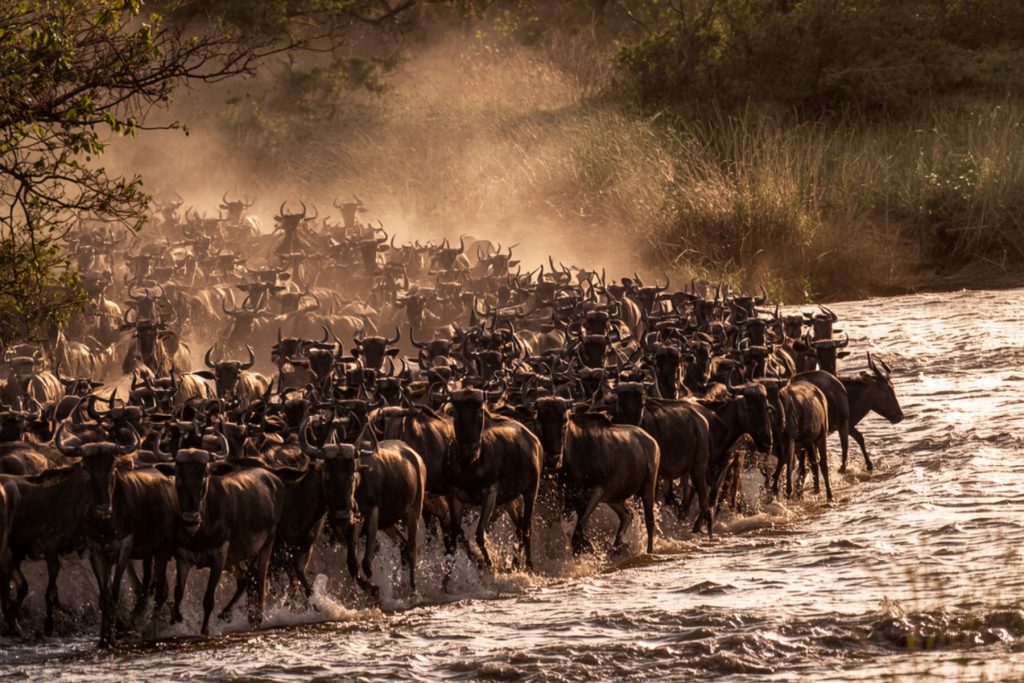
The Great Migration is not a single event with a start and a finish. It is a continuous, year-round loop that carries well over a million wildebeest, along with hundreds of thousands of zebra and gazelle, around the Serengeti and the Maasai Mara in search of fresh grazing and water.
The herds follow the rains, not a calendar, which is why the route bends and the timing shifts a little every year. This guide explains the path the animals take, month by month, and where each stage of the journey unfolds.
What the Great Migration actually is
The migration moves through the Serengeti-Mara ecosystem, a connected expanse of protected land that straddles northern Tanzania and southern Kenya. Over the course of a year, each animal covers somewhere between 800 and 1,000 kilometres, walking a rough clockwise loop that finishes where it began.
There is no leader and no fixed schedule. The herds move because the grass and the water move with the rains, and a herd this large cannot stay in one place for long without grazing it bare.
The scale is what makes it remarkable. Aerial surveys have for decades put the migratory wildebeest at around 1.3 million animals, alongside roughly 200,000 zebra and large numbers of Thomson’s and Grant’s gazelle, eland and impala. That headline figure is now under fresh scrutiny.
A 2025 study published in the journal PNAS Nexus used high-resolution satellite imagery and artificial intelligence to count the herds, and detected fewer than 600,000 wildebeest within the dry-season range.
The researchers were careful to present this as a complementary counting method rather than proof of a decline, and traditional aerial counts continue. Either way, the migration remains the largest overland movement of mammals on Earth.
The animals on the move, and why they travel together
Wildebeest dominate the herds, but they do not travel alone, and the company is not accidental. Zebra graze the longer, coarser grass first, which exposes the shorter shoots that wildebeest prefer. Zebra also have a strong memory for routes and water sources, while wildebeest bring overwhelming numbers.
Travelling together, the two species cover ground more safely than either would alone.
That safety is relative. The herds are trailed the entire way by predators: lion, spotted hyena, cheetah, leopard and wild dog on land, and Nile crocodile at every river. By some estimates around 250,000 wildebeest die each year from predation, drowning, exhaustion and disease.
Those losses feed the predators and fertilise the plains, which is part of why the migration matters far beyond tourism.
The path, month by month
Follow the herds
A year on the move
Where to be:
The loop has no true beginning, but the calving season in the south is the natural place to pick up the story.
December to March: the southern plains and calving
From around December the herds gather on the short-grass plains of the southern Serengeti and the Ndutu area, which sits within the neighbouring Ngorongoro Conservation Area. These plains are rich in minerals drawn from old volcanic ash, which makes for ideal grazing for animals about to give birth.
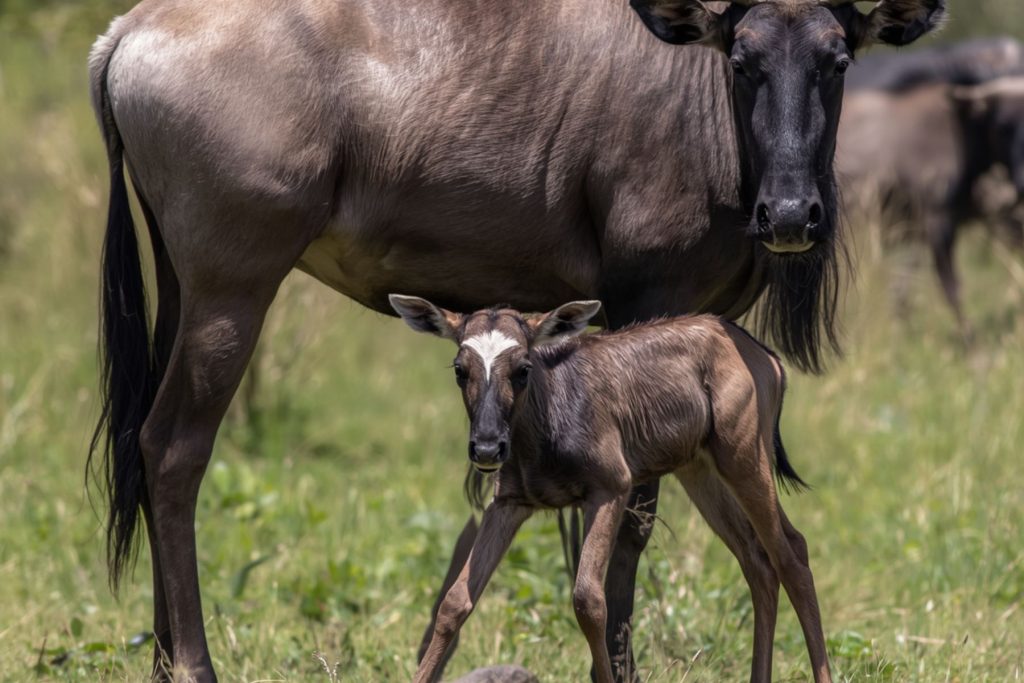
Calving peaks in February, when as many as 8,000 calves can be born in a single day and roughly half a million arrive within a few weeks.
The timing is a survival strategy: predators can only take so many, so flooding the plains with calves at once improves the odds for the herd as a whole. It is one of the best times and places to watch big cats hunting.
April to May: the trek north and the rut
By April the southern plains have been grazed down and the long rains have arrived, so the herds begin moving north and west through the central Serengeti, around the Seronera region.
This is the most dispersed phase of the year, with animals spread across great distances because grass and water are plentiful almost everywhere. May brings the rut, the wildebeest mating season, when bulls compete noisily for females even as the columns keep walking.
Game viewing in these months is good rather than dramatic, and the green landscapes are at their best for photography.
June: the Grumeti River
In June the leading herds reach the Western Corridor and face their first major obstacle, the Grumeti River. The Grumeti is narrower and usually less violent than the crossing that comes later, and in some years low water levels mute the drama.
Even so, large Nile crocodiles wait in its pools, and the crossings can be tense. Because far fewer vehicles reach this part of the Serengeti, June crossings are often watched in relative solitude.
July to October: the Mara River crossings
From July the herds press into the northern Serengeti, around Kogatende, and towards the Mara River on the Tanzania-Kenya border. This is the stage most people picture: thousands of animals massing on a bank, hesitating, then plunging into water patrolled by some of Africa’s largest crocodiles.
Many herds cross into Kenya’s Maasai Mara, including the Mara Triangle, drawn by fresher grazing on the northern side.
Crossings continue through August, September and into October, and the herds often surge back and forth across the river more than once. For viewing from the Kenyan side, July to October is the peak window.
November: the return south
As the short rains begin to fall in the south around November, the herds turn and start the journey back, moving down through the eastern Serengeti. By December they are returning to the southern plains where the calving will begin again, and the loop closes.
The two great river crossings, compared
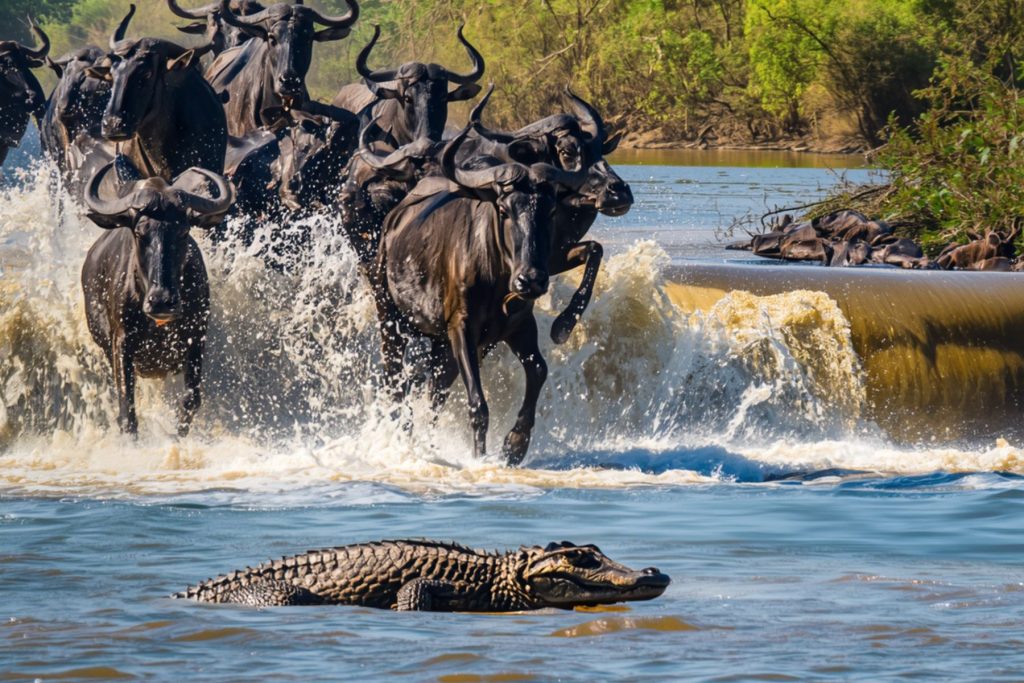
The migration has two famous river crossings, and they are not alike. The Grumeti, in the western Serengeti around June, is the first and the quieter of the two: narrower, less predictable, and watched by few.
The Mara, on the Tanzania-Kenya border from July to October, is the larger and more dramatic, with wider water, bigger crocodiles and far more onlookers. If your priority is the iconic crossing, plan for the Mara in the dry season. If you would rather trade some of the spectacle for solitude, the Grumeti rewards you.
Why the path is never exactly the same
The sequence above repeats every year, but the precise timing and route do not. The herds follow rainfall, and rain is not punctual. A late or early season can shift a river crossing by two or three weeks, and in some years the population splits, with part of it veering west to the Grumeti while the rest pushes straight north. No one can promise a crossing on a particular date.
The most reliable approach is to be in the right region for the season and to allow yourself several days, rather than chasing a single event. A guide who knows where the herds are this week is worth far more than a fixed schedule.
Where to be, and when, to see it
The simplest way to plan is to match the month to the region.
- For the calving season, be on the southern Serengeti plains and around Ndutu between late January and March.
- For the Grumeti crossings and the green-season landscapes, aim for the Western Corridor in June.
- For the Mara River crossings, the climax of the year, choose the northern Serengeti from July onwards, or cross to the Maasai Mara in Kenya between July and October.
A migration safari often pairs the two countries, with time in Tanzania for the Serengeti and a few days in Kenya for the Mara. You can see how we build these trips on our Great Migration safaris page, where each itinerary is matched to the season you want to travel.
Plan your Great Migration safari
The migration rewards travellers who plan around the herds rather than the calendar. Tell us when you can travel and what you most want to see, whether that is the calving, the rut or the river crossings, and we will place you in the right reserve at the right time. Start planning your Great Migration safari with a specialist who has followed the herds first-hand.